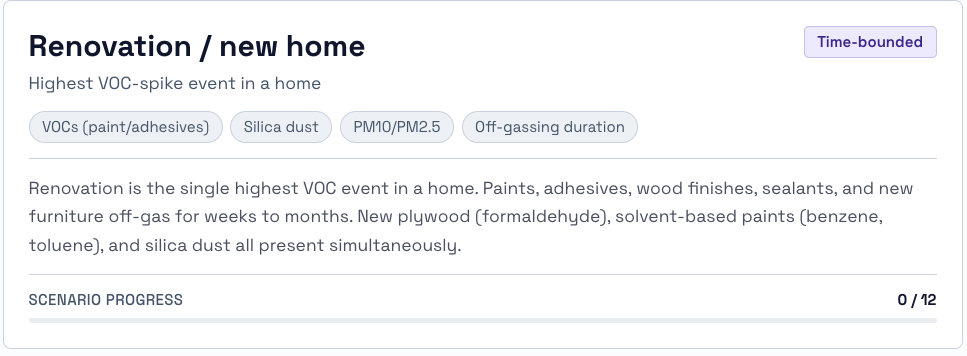
Renovation is the single highest VOC-spike event most homes will ever see. Paints, adhesives, wood finishes, sealants and new furniture all off-gas at once, some for weeks, others for months. New plywood releases formaldehyde, solvent-based paints release benzene and toluene, and cutting and sanding add silica dust. Unlike most air quality problems, this one has a defined beginning and end, which makes it worth managing deliberately rather than waiting it out. This guide covers VOCs, silica dust, PM10/PM2.5 and off-gassing duration: what matters before, during and after a renovation, and what to do about it.
Formaldehyde shows why timing matters. Most off-gassing from urea-formaldehyde resins, used in MDF and particleboard, happens in the first six to twelve months, sharpest in the first few weeks. Levels then decline steadily, though traces can persist for two to five years, and one chamber study of a high-emitting laminate flooring sample estimated several years before emissions became negligible (NonToxicLab, New Home Off-Gassing: How Long It Lasts and What to Do; EngineerFix, How Long Does Plywood Offgas Formaldehyde?; My Chemical-Free House, When Does MDF and Particleboard Offgas Formaldehyde?). The outer number is not the point. A renovation is not a one-week problem: the phase affecting daily comfort runs for months.
Silica dust is the less-discussed hazard, and not a minor one. A study of indoor demolition and renovation measured a geometric mean respirable dust concentration of 0.88 mg/m³, peaking at 29 mg/m³, and found workers not performing the dusty task were still meaningfully exposed just from sharing the space (Measurements of dust and respirable crystalline silica during indoor demolition and renovation, Annals of Work Exposures and Health, 2025). Those figures come from professional demolition sites, so a flat repaint or cabinet installation will not reach them. The second finding transfers regardless: you do not need to be the one cutting or sanding to breathe what it produces. The same logic runs through our guide to construction dust in Indian cities.
None of this is a reason to delay a renovation. It means ventilation, filtration and timing matter more here, for longer, than almost anywhere else in the home.
What actually matters before, during and after
Four things drive most of the risk:
- VOCs from paint and adhesives, spiking during active work and off-gassing for weeks afterwards
- Silica dust, from cutting, drilling and sanding, drifting well beyond the work area
- PM10/PM2.5, from nearly every renovation activity, demolition to sanding to moving materials
- Off-gassing duration, because the risk does not end when the workers leave; it tapers over months as new materials keep releasing what they were made with
If you want the wider picture of what is in your indoor air beyond a renovation, our guide to the nine pollutants that matter covers the rest, and the glossary defines the terms used here.
What to do right now
These do not require buying anything, and apply for as long as active work is happening.
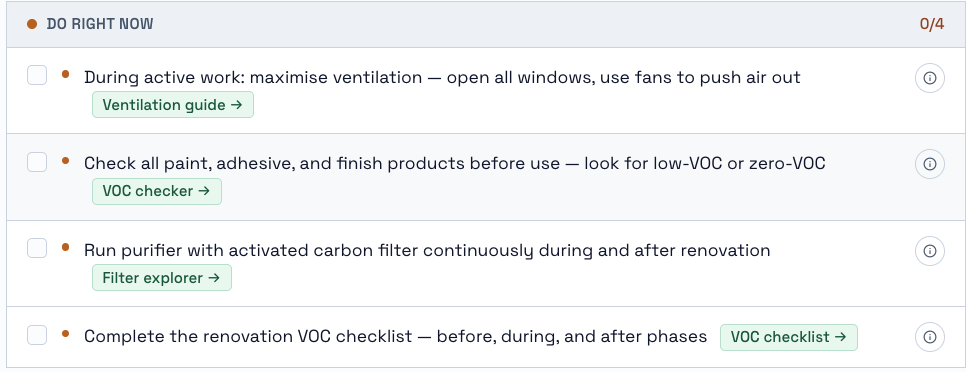
During active work, maximise ventilation. Open all windows and use fans to push air out rather than circulate it. This matters most during the sharpest spikes: painting, sanding and adhesive application. Our ventilation guide covers the setup, and when opening windows helps or hurts explains the outdoor-AQI trade-off.
Check all paint, adhesive and finish products before use. Look for low-VOC or zero-VOC labelling rather than assuming a mild smell means safe. Some low-odour products still carry meaningful VOC content. Run yours through our VOC checker before it goes on the wall.
Run a purifier with an activated carbon filter continuously during and after renovation. A standard HEPA filter captures particles, not gases. It does nothing for the formaldehyde, benzene and toluene off-gassing from paint and pressed wood, because VOC molecules are far smaller than what particle filtration catches (IQAir, Do air purifiers remove VOCs?). Only activated carbon addresses the gas-phase problem. Use our filter explorer to check whether your purifier has one.
Complete the renovation VOC checklist for the before, during and after phases. Renovation risk has no single peak; it shifts across the project. Our VOC checklist is structured around that rather than as a one-time check.
What to set up once
These take more effort but only need doing once, and hold for the whole project.
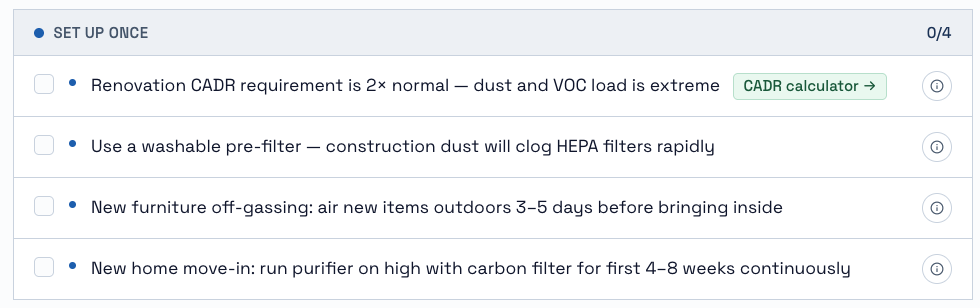
Size the purifier's CADR at roughly twice the normal recommendation. A room mid-renovation carries a dust and VOC load standard sizing does not anticipate. Use our CADR calculator and size for the renovation phase, not the finished room. If you are buying a machine for this, our buying checklist and Find a purifier tool both flag whether a model carries real carbon.
Use a washable pre-filter in front of the main filter. Construction dust is far more abundant than household dust, and a pre-filter catching that load first is standard practice to stop the carbon stage clogging and losing effectiveness (Custom Filters Direct, Does Activated Carbon Remove VOCs?). The same logic protects the HEPA stage and avoids the airflow drop from a loaded filter. Washable means rinsing rather than replacing.
Air new furniture outdoors for three to five days before bringing it inside. New MDF or particleboard furniture is often the largest ongoing formaldehyde source in a renovated home. The most intense off-gassing runs roughly four weeks, not a few days (NonToxicLab), so three to five days takes the edge off but does not replace carbon filtration and ventilation for weeks afterwards. Longer outdoors is better.
For a new home move-in, run the purifier on high with a carbon filter for the first four to eight weeks. This is when off-gassing is most concentrated, before it settles into the slower tail.
Signs worth watching for
A few things worth noticing well after the visible work is finished.
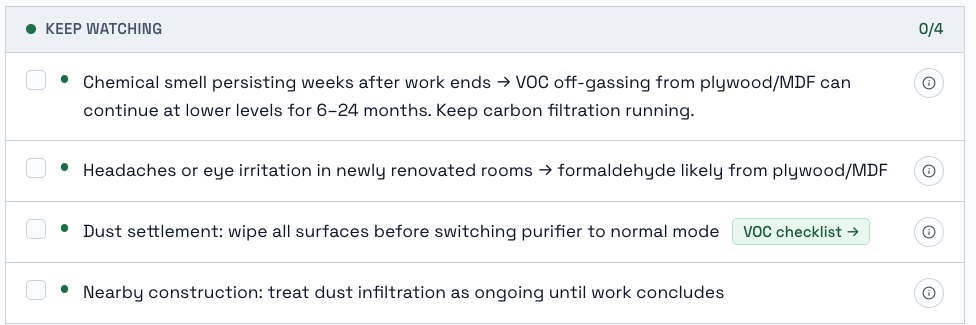
A chemical smell persisting weeks after work ends. Usually VOC off-gassing from plywood or MDF, which declines over months but can stay measurable well beyond a year in urea-formaldehyde products. Keep carbon filtration running rather than treating a fading smell as the risk passing. Our guide to what a stale smell does and does not tell you is worth reading alongside this.
Headaches or eye irritation in newly renovated rooms. Eye, nose and throat irritation with headaches are recognised short-term VOC effects, and formaldehyde from plywood or MDF is a likely candidate here. Worth investigating, particularly if symptoms track with time in that specific room, or if a toddler sleeps or plays in it.
Dust settlement after active work ends. Wipe all surfaces before switching the purifier back to normal mode. Settled dust is resuspended by ordinary movement, so a room can look clean while still putting particles back into the air. Our note on vacuuming soft surfaces covers the resuspension problem.
Nearby construction, even if it is not yours. Treat dust infiltration as ongoing for as long as the external work continues, not just on the noisiest days.
Bottom line
Renovation concentrates three hazards into one project: VOCs, silica dust and particulate matter. The fourth problem is duration, because none of them stop when the visible work does. The upside is that this is time-bounded, so effort spent has an end date.
Ventilate aggressively during active work, use activated carbon rather than assuming HEPA is enough, size the purifier for the renovation load rather than the finished room, and keep watching for chemical smells or irritation for months after the last coat has dried.
For a personalised version of this checklist based on your specific renovation and home, use our Personal IAQ Checklist tool.
Questions about your own renovation? Email us at indoorairguide@outlook.com.
Related reading: VOCs in Indian homes for the material-by-material detail, construction dust for the outdoor side of the same problem, and the VOC reduction checklists for the phase-by-phase version.
Sources: Formaldehyde off-gassing duration and intensity phases from pressed wood products: NonToxicLab, New Home Off-Gassing: How Long It Lasts and What to Do; EngineerFix, How Long Does Plywood Offgas Formaldehyde?; My Chemical-Free House, When Does MDF and Particleboard Offgas Formaldehyde? (chamber study of a high-emitting laminate sample). Dust and silica exposure during indoor renovation: Measurements of dust and respirable crystalline silica during indoor demolition and renovation, Annals of Work Exposures and Health (2025). HEPA versus activated carbon filtration for VOCs: IQAir, Do air purifiers remove VOCs?. Pre-filter use to protect activated carbon media from particulate clogging: Custom Filters Direct, Does Activated Carbon Remove VOCs?. Short-term irritation effects of VOC exposure: SimPure, Do HEPA Filters or Activated Carbon Filters Remove VOCs?