Measured indoor VOC levels in Indian homes exceed outdoor levels and roughly double in winter. Most product labels disclose almost none of what a product emits. This is a guide to the four ingredient families worth recognising, and what to do about them.
Almost nothing in an Indian home tells you how much it will pollute your air. Paint tins rarely carry a VOC figure. Floor cleaners list "fragrance" and stop there. Furniture arrives with no emissions data at all. The information a buyer would need is, in most cases, not printed on the product.
This is a guide to what has actually been measured in Indian homes, why the label is usually incomplete, which ingredient names are worth recognising, and what to do with a product once you know what is in it.
The companion tool is the VOC Ingredient Checker. It does not invent a rating system. It reads a label — or a one-tap preset for products already in Indian homes, from Lizol and Harpic to Odonil, Good Knight, Fevicol and naphthalene mothballs — and checks the named ingredients against the WHO Indoor Air Quality Guidelines from 2010.
The aim is not to empty the cupboard. It is to stop treating "fragrance," "solvent," and "natural citrus" as if they were empty words.
What has been measured inside Indian homes
The most directly relevant study is a 2022 pilot in Environments, which quantified hundreds of VOCs inside and outside 26 homes in Ahmedabad and Gandhinagar across two seasons. Three findings matter:
- Winter 327 µg/m³, summer 150 µg/m³ — total indoor VOCs, roughly double in the cold months
- Indoors beat outdoors in both seasons — the sources are inside the house
- Cooking, plastics and plasticisers, consumer products, siloxanes and vehicles — the contributing sources identified
A study of homes and hostels in New Delhi found the same thing: eleven monitored aromatic and halogenated VOCs all showed indoor-to-outdoor ratios above 1.0, which the authors read as evidence of indoor sources rather than infiltration.
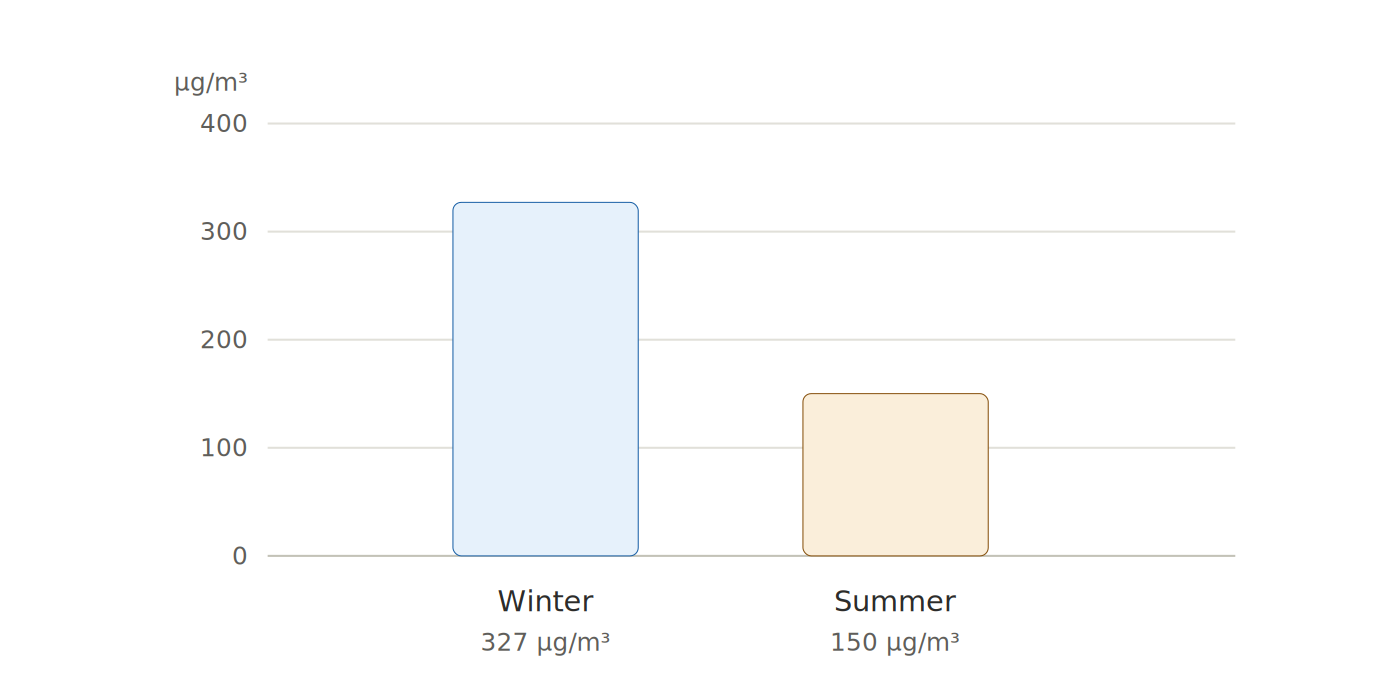
That first point is the one that should change how you think. Outdoor AQI is a reasonable proxy for the particulate matter you breathe indoors. It tells you nothing about VOCs, because the sources are inside with you.
The seasonal pattern is not a Gujarat quirk either — work on BTEX in Gorakhpur homes, published in Chemosphere, also found levels highest in winter. Reduced ventilation is the likely mechanism: a year-long study of UK homes measured air change rates falling from a median of 1.2 per hour in summer to 0.70 in winter.

The mix shifts with the weather too. In May, plastics and plasticisers accounted for a mean 42% of indoor VOCs in the Ahmedabad homes; by January that share had fallen to 4%, with cooking and consumer products taking over. Heat pulls chemicals out of materials; closed windows then trap whatever is being used inside.
Routine burning adds its own load. Sampling across ritual burning environments in Raipur, published in Aerosol and Air Quality Research, found annual mean total VOCs of 656 and 682 µg/m³ at two sites against 83 µg/m³ at a residential comparison site.
What counts as a high number
A fair question is what these figures should be measured against. The honest answer is that there is no health-based reference. No health standard exists for indoor total VOCs in non-industrial settings, which is why studies borrow the 500 µg/m³ limit from the LEED building scheme instead. India has no standard of its own. Both Indian seasonal averages sit below the LEED figure.
Worth saying plainly rather than glossing over: the case for paying attention is not that Indian homes are hitting dangerous absolute levels. It is that concentrations double seasonally, exceed outdoor levels, and come from sources you can identify and control. The European Collaborative Action report that defined TVOC said much the same about its limits — not usable as a predictor of health effects, but useful for characterising pollution and guiding source control.
TVOC is a lump sum. Formaldehyde, benzene, limonene and a glycol ether are not interchangeable. That is why reading which ingredients are present matters more than staring at a single "VOC" number — even if the tin had one. The glossary defines the terms used here.
Why the label does not tell you what is in the product
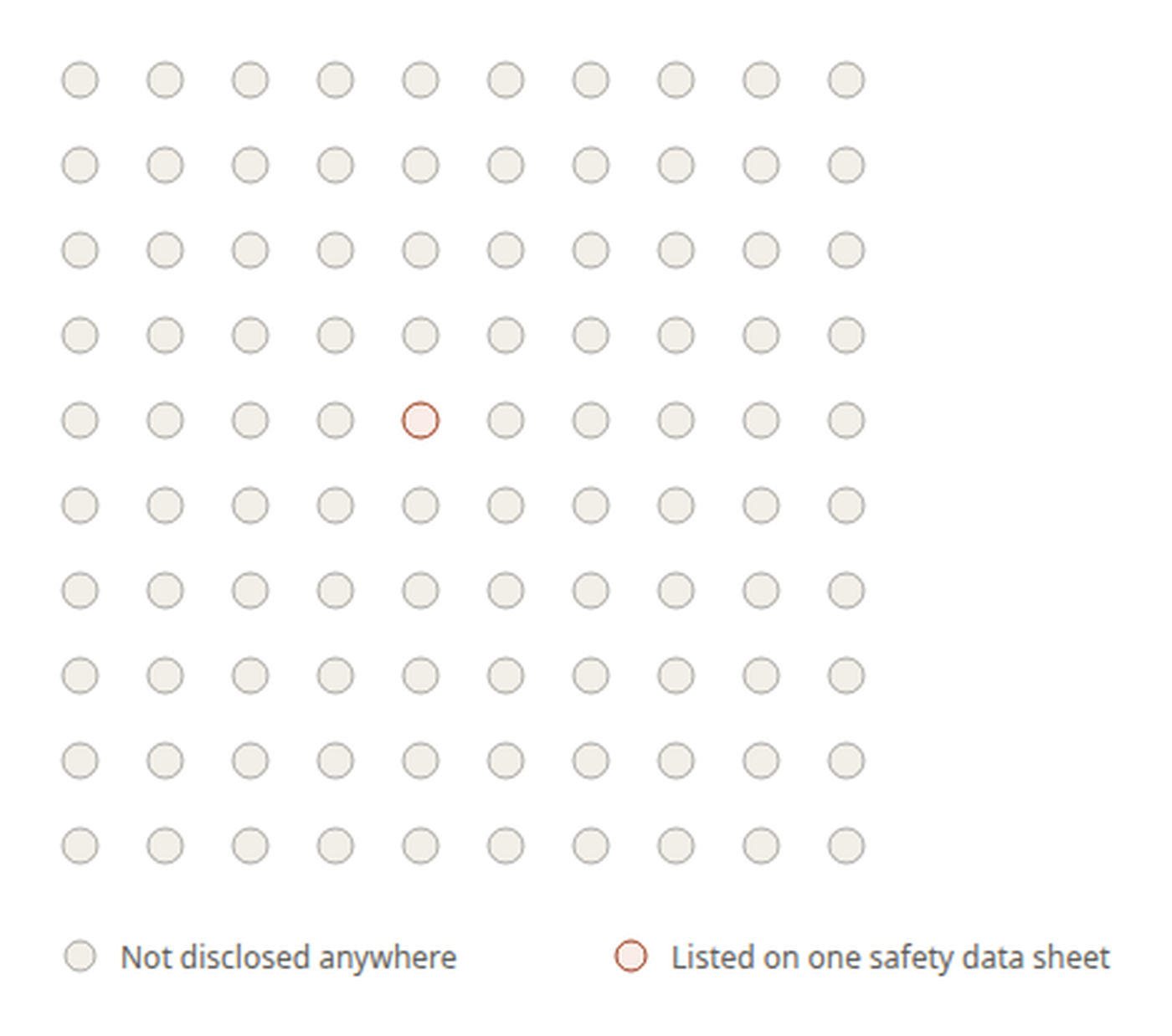
The clearest evidence comes from Anne Steinemann's work in Environmental Impact Assessment Review. In a 2009 analysis, six best-selling air fresheners and laundry products were tested by gas chromatography. Nearly 100 volatile organic compounds were identified across them. None appeared on any product label, and exactly one appeared on a single safety data sheet. Ten of the identified compounds are regulated as toxic or hazardous under US federal law; three are classified as hazardous air pollutants.
A 2011 follow-up widened the sample to 25 fragranced products spanning laundry supplies, personal care items, cleaning products and air fresheners. It identified 133 different VOCs, an average of 17 per product, of which 24 are classified as toxic or hazardous under US law.
The reason is structural rather than uniquely Indian, and not always deceptive: consumer products outside food, drugs and cosmetics face no general requirement to disclose specific ingredients, and fragrance formulations are treated as proprietary. One word — "fragrance," "parfum" — can stand in for dozens of compounds.
Indian labels add a second problem. Most products that off-gas here print no "VOC content" figure at all, just an ingredient list the typical buyer cannot interpret: limonene, alpha-pinene, formaldehyde-donor preservatives, glycol ethers, naphthalene. The information exists; it is not usable without a key.
So an ingredient list is a floor, not a ceiling. What is named is real. What is unnamed is unknown rather than absent.
The four families worth recognising
Ingredient lists are long and mostly unreadable. Four groups account for most of what matters in a home.
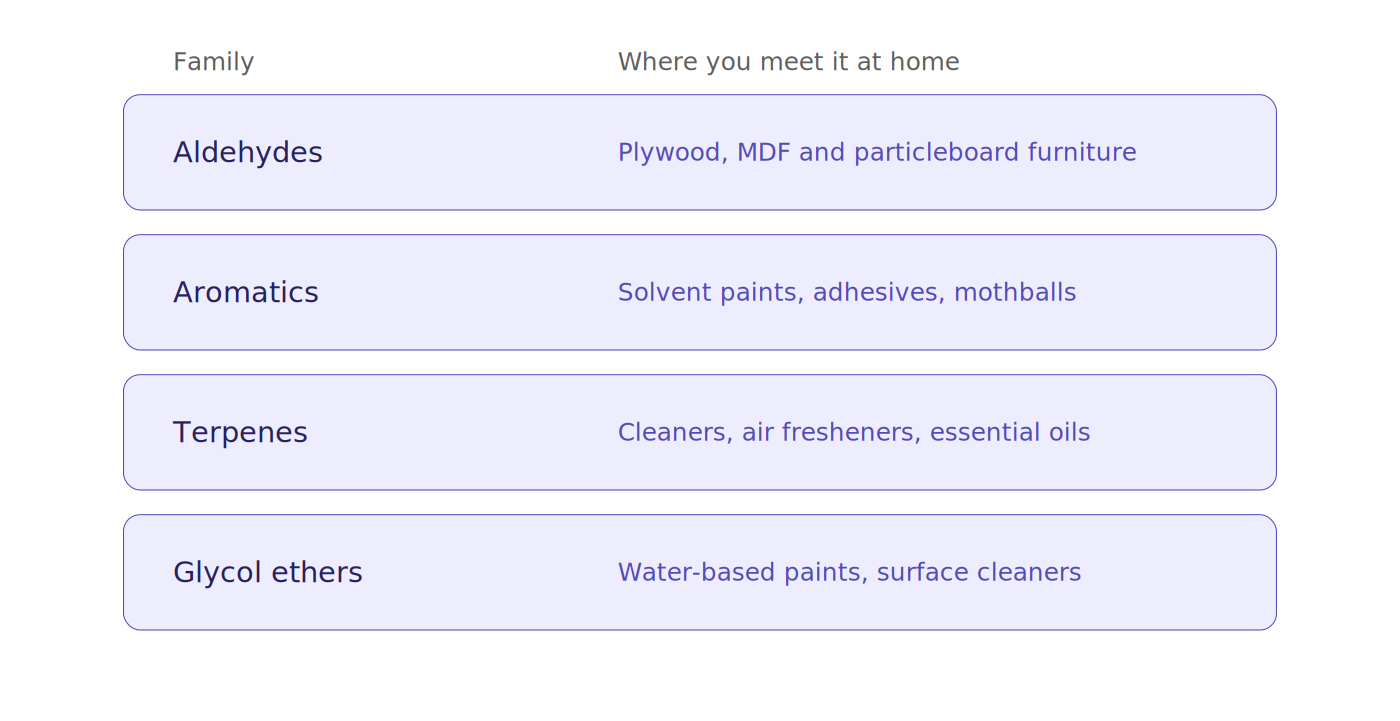
Aldehydes. Formaldehyde is the one to know. In residential settings it is emitted largely from furniture built with particleboard and urea-formaldehyde resins. Its main route into a home is furniture and cabinetry. Some cleaners and cosmetics also use formaldehyde-donor preservatives, but the move-in spike is almost always the boards. WHO's indoor-air guideline for formaldehyde is 0.1 mg/m³ as a 30-minute average. New plywood wardrobes, modular kitchens and laminate flooring are the usual first week of a move-in smell — the subject of our renovation guide.
Aromatic hydrocarbons. Benzene, toluene, ethylbenzene and xylenes — BTEX — usually present as solvents, and the group the Gorakhpur and Delhi studies tracked. Elevated exposure is associated with mucous-membrane irritation, difficulty concentrating, nausea and headache. Naphthalene, the mothball chemical, sits in the same family and has its own WHO guideline: 0.01 mg/m³ as an annual average. WHO went further than a limit and recommended dropping naphthalene mothballs entirely. They have been banned as pesticides in the EU since 2008; they remain easy to find in Indian markets.
Terpenes. Limonene and alpha-pinene, giving citrus and pine scents, found in cleaners, polishes, air fresheners and essential oils. A study in Atmosphere across nine homes found d-limonene at high concentrations and with unusually wide variability, which the authors put down to differing occupant habits — a compound driven by what people do, not by the building. Their principal risk is indirect, which is the next section.
Glycol ethers. Common in water-based paints and surface cleaners as coalescing agents and solvents. Less discussed than the others, but a routine contributor to total load, and easy to miss because "water-based" is often sold as if it meant "no solvents."
Why "natural" scents are not automatically safer
Terpenes are not especially hazardous to inhale directly at ordinary household concentrations. The problem is what they become. Ozone is routinely present indoors because ventilation brings in outdoor air containing it, and terpenes react with it to form new compounds, including formaldehyde and ultrafine particles. Research in Environmental Pollution notes that photochemically formed ozone entering from outdoors can reach up to 70% of outdoor concentrations. A citrus-scented cleaner therefore does not simply add limonene to a room. In the presence of ozone it generates a second set of pollutants that were never in the bottle.
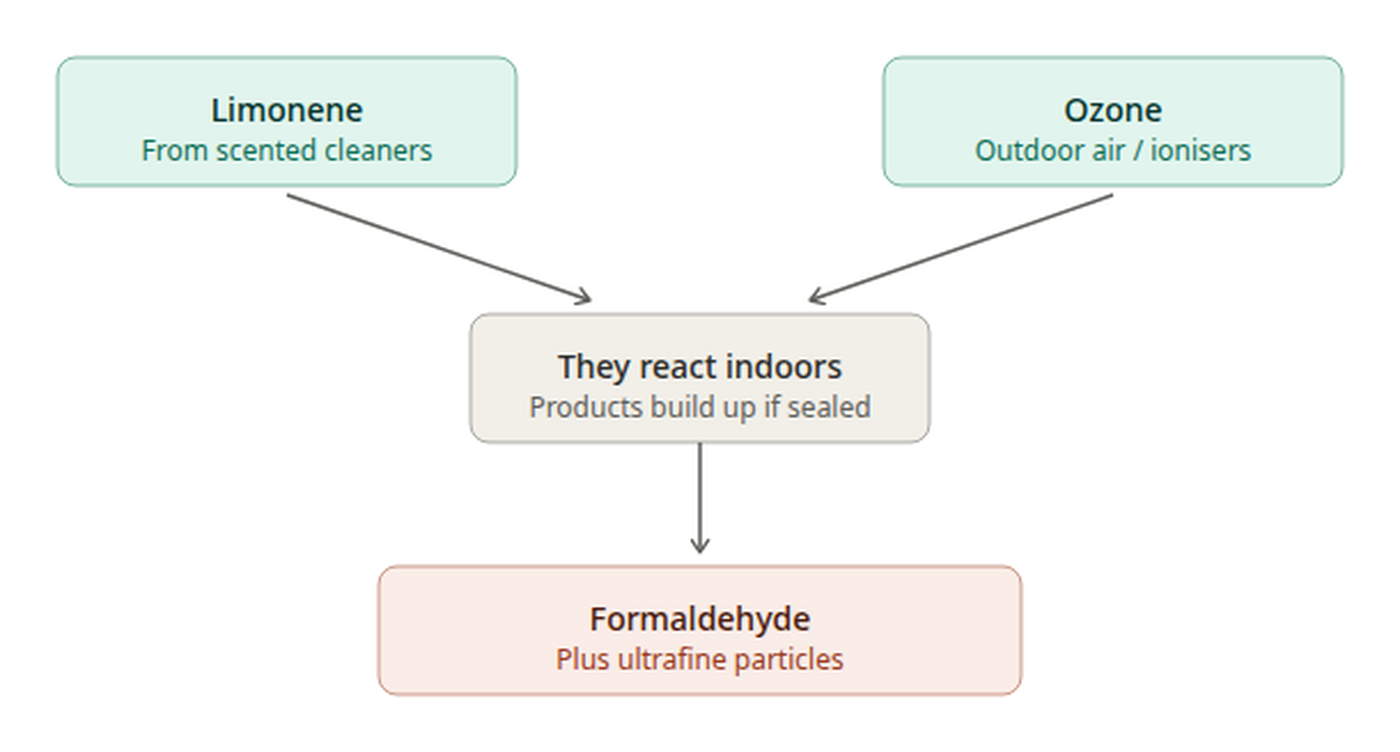
Limonene is the more reactive of the two. Being doubly unsaturated gives it a considerably higher potential to form secondary organic aerosol than alpha-pinene: work in Atmospheric Environment found ozone reacting with d-limonene produced roughly five times the particle number that alpha-pinene did.
Two common Indian conditions make it worse. Low air-exchange rates shift the resulting particles toward larger sizes and raise their total mass — which is exactly a sealed flat during a high-AQI week, when air-change rates are already at their winter low. And ozone-enriched air raises the concern substantially, partly through formaldehyde production. That is the case against running an ioniser or ozone-generating device alongside heavily fragranced products: the combination is worse than either alone. If you are unsure whether a device you own makes ozone, establish that first.
The takeaway is not to avoid every scented product. It is that "plant-derived" and "essential oil" describe a product's origin, not its behaviour in your air. An unscented version of the same cleaner avoids the secondary chemistry entirely. A diffuser running all afternoon in a closed bedroom is a different object from a drop of lemon oil on a cloth.
Reading a label in practice
Start with the category, not the ingredients. Renovation materials, strong-fragrance cleaners, air fresheners, new pressed-wood furniture, mothballs and diffusers account for most of the household load. A bar of soap does not need this scrutiny.
Note what is missing. A label reading "fragrance," "parfum" or "solvents" without further detail is withholding information, legally and routinely. Treat an unspecified fragrance as an unknown quantity rather than a neutral one.
Then read the named ingredients. Match them against the four families above. This is the step most people will not do by hand.
Open the VOC Ingredient Checker. Three ways in:
- Tap a preset if the bottle is one of the common Indian products already loaded.
- Paste the ingredient list if you have it.
- Upload a photo of the pack if you do not want to type.
The checker screens against WHO's 2010 indoor-air guidelines and flags only the VOCs with a health context worth acting on. WHO 2010 covers a short list — formaldehyde, benzene and naphthalene among them — so terpene flags rest on the indoor-chemistry literature instead, and the tool says which basis it is using. Each flag gives you:
- The family — aldehyde, aromatic, terpene or glycol ether
- The usual exposure route
- What to do — ventilate during use, store outside the bedroom, substitute, or leave it alone
Low-risk results are explicit, so a glass cleaner does not get treated like a tin of solvent adhesive.
A worked example: tap "Naphthalene Mothballs"
The cleanest demonstration, because the pack is a single named chemical and WHO wrote a chapter about it. Naphthalene sublimes — it goes from solid to vapour at room temperature, which is the entire point of a mothball. What that chapter establishes:
- Guideline: 0.01 mg/m³, as an annual average
- Background without mothballs: about 0.001 mg/m³, near the detection limit
- With mothballs: residential concentrations can rise up to a hundredfold
- Principal concerns: respiratory-tract lesions in animals, haemolytic anaemia in humans
- WHO's own conclusion: the most effective protection is to stop using them altogether
The checker's output follows that chapter rather than inventing a score. It returns the hazards — respiratory damage, blood disorder, possible carcinogen (IARC Group 2B) — the 0.01 mg/m³ annual average, and three practical notes:
- Do not use near children's clothing or in closed wardrobes
- Ventilate if they are already in the house
- Switch to cedar or lavender if you only need a deterrent
The red "Concern" bar means a WHO indoor guideline exists and this product is built to exceed background by design. It is not a claim that one mothball in a sealed trunk equals the animal cancer studies.
Cedar blocks and lavender sachets are weaker as killers of larvae and better as everyday deterrents. They also do not fumigate a lived-in wardrobe.
The same tap-through works for the other presets. Odonil and a citrus floor cleaner will surface terpenes. A solvent adhesive will surface aromatics. Tractor Emulsion will surface whatever the tin actually lists, which is the point of reading the label instead of the marketing line "water-based."
What to do with a product you still want to use
Most high-VOC products have no practical substitute, or the substitute is worse on some other axis. The goal is managing exposure, not eliminating the product.
Ventilate during use and afterwards. Emissions continue past the point where you stop noticing the smell. The site's ventilation guide covers timing, including how to judge whether outdoor air is currently clean enough to bring in.
Ventilate harder in winter. This is where the Indian measurement data is most directly actionable: indoor VOC concentrations roughly double in the season when people are least inclined to open windows, and air-change rates drop by around 40%. A short cross-breeze after cooking, mopping with a fragranced cleaner, or lighting incense is worth more in January than in May.
Store outside the living area. Sealed containers, and not in a bedroom cupboard or enclosed utility space sharing air with rooms you sleep in. Mothballs and spare paint are the obvious cases.
Use activated carbon, not HEPA, for the gas phase. A HEPA filter captures particles and does nothing for VOC molecules. Only sufficient activated-carbon media addresses gases. If the product also generates ultrafine particles via terpene–ozone chemistry, HEPA becomes relevant again — for the particles, not for the parent terpene.
Separate sources in time. Painting, deep-cleaning with fragranced products, unwrapping new furniture and running a diffuser in one week stacks four loads together. Spacing them gives the room time to clear.
Do not pair citrus with an ioniser. If the checker flags limonene or pinene and you own an ozone-generating or ionising device, pick one of them to turn off.
Bottom line
Measurements from Indian homes show indoor VOC concentrations exceeding outdoor levels, roughly doubling in winter, and driven by sources inside the house rather than infiltration from outside. Product labels routinely omit most of what a product emits, so the ingredient list is a floor rather than a full account.
What remains within a buyer's control is real: recognise the four ingredient families, treat unspecified "fragrance" as missing information rather than reassurance, keep terpene-heavy products away from ozone-generating devices, and ventilate hardest in the season when indoor concentrations are highest and windows are most likely to stay shut.
To check a specific product, open the VOC Ingredient Checker, tap a preset or paste the list.
Related on this site
This page is the label-reading companion. For health effects, renovation timing and certified paints, start with VOCs: what they are, who they harm, and what to do. For room-by-room actions, use the VOC reduction checklists. For whether to open a window after you use the product, use the ventilation guide. New furniture and paint: indoor air during a renovation.
Check a pack now: VOC Ingredient Checker.
Questions about a specific product label? Email us at indoorairguide@outlook.com.
References: Norris, C.L. et al. (2022), "A Pilot Study to Quantify Volatile Organic Compounds and Their Sources Inside and Outside Homes in Urban India," Environments 9(7): 75, doi:10.3390/environments9070075. Kumar, A. et al., "Determination of volatile organic compounds and associated health risk assessment in residential homes and hostels within an academic institute, New Delhi," PMID 24438189. Masih, A. et al. (2017), "Exposure profiles, seasonal variation and health risk assessment of BTEX in indoor air of homes at different microenvironments of a terai province of northern India," Chemosphere. Year-long study of indoor VOC variability, PMC11921335. "Indoor VOCs from Religious and Ritual Burning Practices in India," Aerosol and Air Quality Research, doi:10.4209/aaqr.2013.09.0291. Steinemann, A.C. (2009) and (2011), "Fragranced consumer products and undisclosed ingredients" / "Chemicals emitted, ingredients unlisted," Environmental Impact Assessment Review. "VOCs Measurements in Residential Buildings," Atmosphere (2019). Terpene–ozone chemistry: Atmospheric Environment (2006, 2008); Environmental Pollution (2017); Sensors, PMC2996213. "Variability of TVOC in the Indoor Air of Retail Stores," PMC6926805 — absence of a health standard; LEED 500 µg/m³. Seifert, B. et al., European Collaborative Action Report No. 19, Total Volatile Organic Compounds (TVOC) in Indoor Air Quality Investigations. World Health Organization (2010), WHO guidelines for indoor air quality: selected pollutants — formaldehyde 0.1 mg/m³ (30-min); naphthalene 0.01 mg/m³ (annual).
Independent indoor-air resource for Indian homes. Not affiliated with any brand.