Toddlers are more vulnerable to indoor air pollutants than adults, and not for vague reasons. This applies to children roughly one to three years old, the range most paediatric bodies, including the American Academy of Pediatrics and WHO, define as toddlerhood.
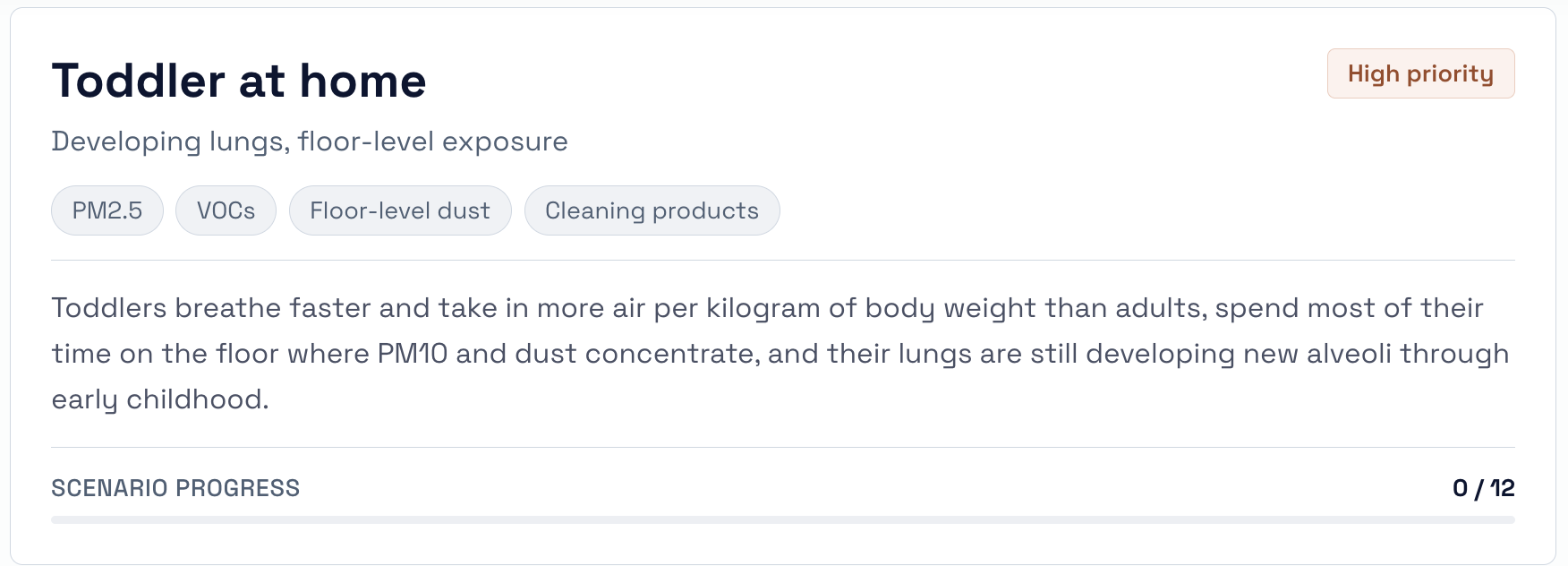
Toddlers breathe faster and take in more air relative to their body weight than adults do, which increases how much of any pollutant in a room they actually inhale (CDC, Children's Environmental Health). They spend most of their waking hours close to the floor, well below an adult's breathing height, where dust, pet dander and heavier particles settle and concentrate. And their lungs are still developing: the classic estimate is that new alveoli, the tiny air sacs where gas exchange happens, keep forming through early childhood, roughly ages three to seven, though more recent imaging research suggests this process may continue for longer than once thought.
None of this means a toddler's room needs to be sterile. It means the basics matter more here than almost anywhere else in the home.
What actually matters in a toddler's room
Four things do most of the work:
- PM2.5, the fine particulate matter that infiltrates from outdoor pollution and also comes from cooking, incense and mosquito coils
- VOCs, the chemical vapours released by paint, synthetic furnishings, cleaning products and new plastic toys
- Floor-level dust, which settles exactly where a toddler crawls, sits and plays
- Cleaning products, which cause real, measurable VOC spikes during and after use, sometimes lasting for hours
What to do right now
These do not require buying anything.
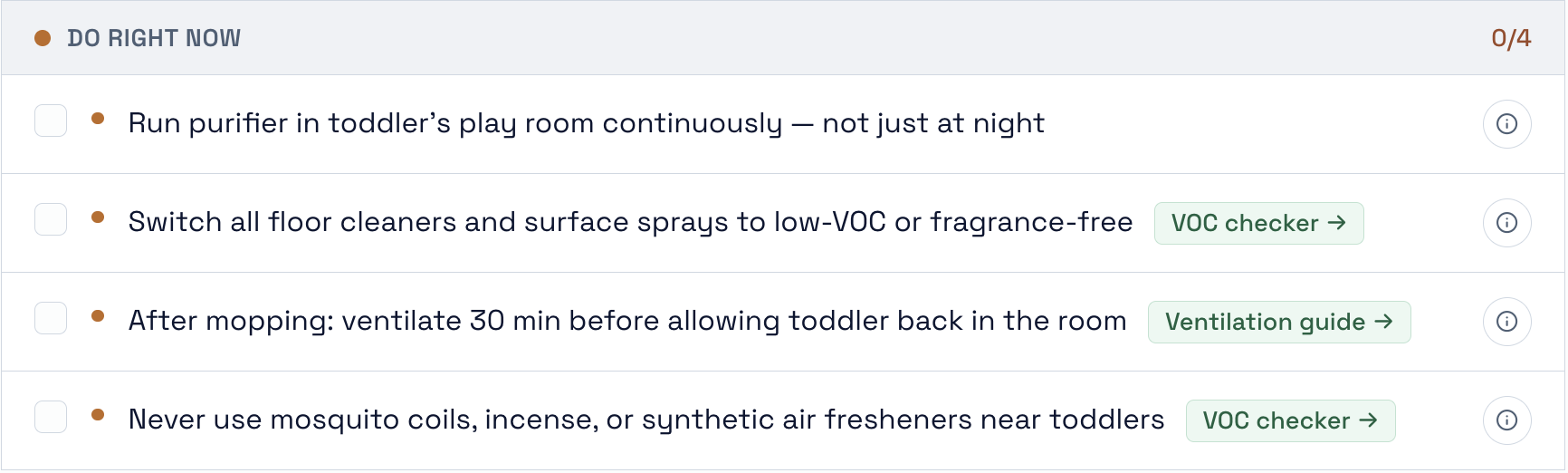
Run the purifier in the toddler's room continuously, not just at night. A purifier switched on only at bedtime misses the daytime hours when a toddler is actually on the floor playing, which is when floor-level dust exposure is highest.
Switch floor cleaners and surface sprays to low-VOC or fragrance-free versions. Fragranced cleaning products cause a real, if temporary, VOC spike each time they're used. Check labels or use our VOC checker on what you already have.
Ventilate for 30 minutes after mopping before letting the toddler back into the room. Wet mopping temporarily raises VOC concentrations from the cleaning agent itself; give it time to clear. Our ventilation guide can help you judge when outdoor air is clean enough to use for this.
Never use mosquito coils, incense or synthetic air fresheners near toddlers. One burning mosquito coil releases roughly the same mass of PM2.5 as 75 to 137 cigarettes (Liu et al., Environmental Health Perspectives). If mosquito protection is needed, a physical barrier (net, screen) is the safer option in a child's room.
What to set up once
These take more effort but only need doing a single time.
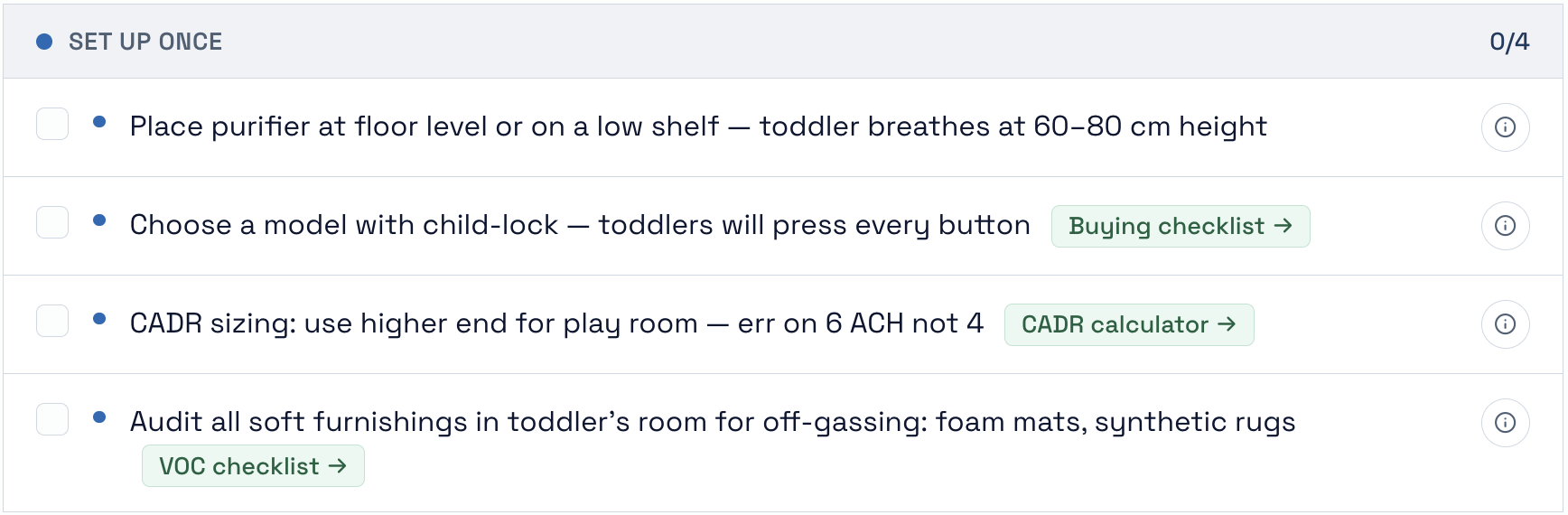
Place the purifier at floor level or on a low shelf, not up high. A toddler's breathing zone is much closer to the floor than an adult's, especially when playing, and a purifier mounted high in the room is drawing in and cleaning air the toddler isn't actually breathing.
Choose a model with a child-lock. Toddlers will press every button they can reach; a child-lock prevents mode changes or accidental shutdowns you won't notice until air quality has already dropped.
Size for the higher end of the range: aim for 6 ACH, not the standard 5. Our own ACH Calculator and CADR Calculator recommend 6 to 8 air changes per hour for sensitive occupants, which includes children under five, rather than the 5 ACH baseline used for a typical adult room.
Audit soft furnishings in the toddler's room for off-gassing. Foam play mats and synthetic rugs are common, underappreciated VOC sources, particularly when new. Run anything you're unsure about through our VOC checklist.
Signs worth watching for
A few things worth noticing as you go, even after the basics are in place.
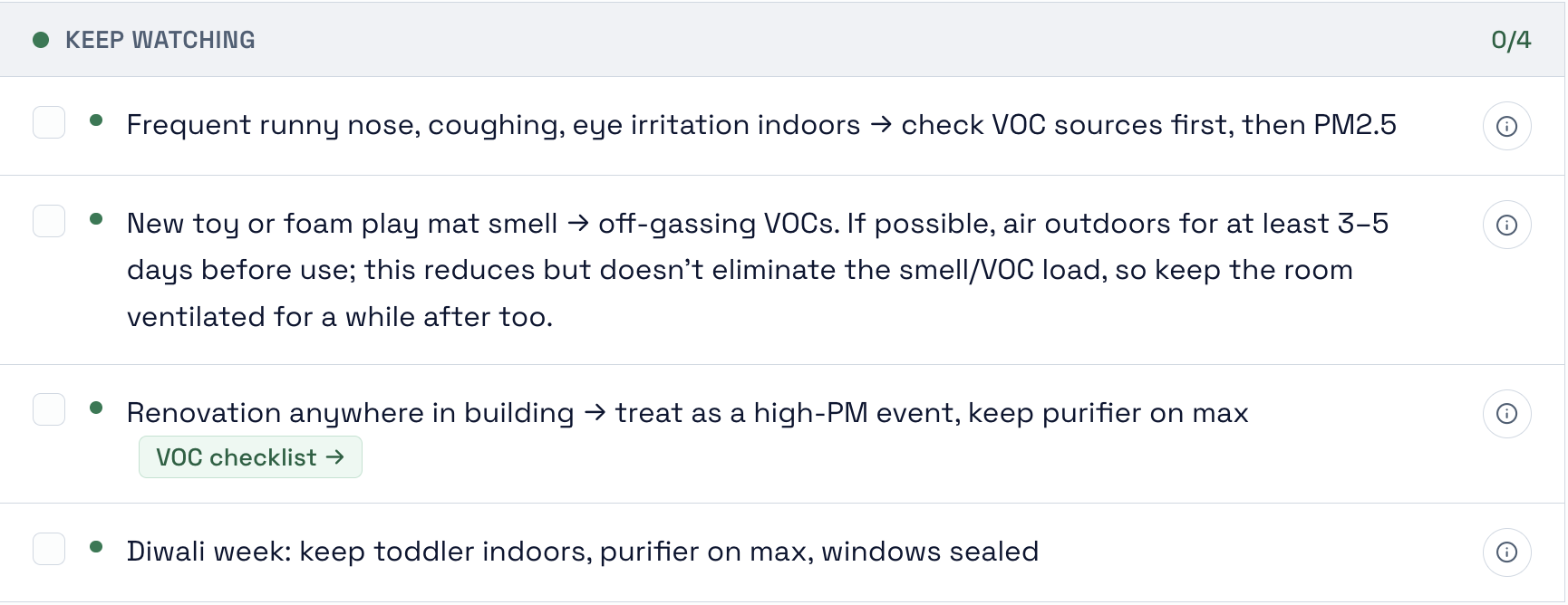
Frequent runny nose, coughing or eye irritation indoors. Check both VOC sources and PM2.5. Both cause overlapping irritation symptoms, so a chemical source (a cleaning product, new furniture, fresh paint somewhere in the home) is just as worth ruling out as particulate pollution.
A new toy or foam play mat has a strong smell. That smell is off-gassing VOCs. Air it outdoors for at least three to five days before regular use. This meaningfully reduces, but does not eliminate, the VOC load: off-gassing continues at a lower level for weeks afterward, so keep the room ventilated for a while even after the smell has faded.
Renovation work anywhere in the building, not just your own flat. Construction and renovation dust and VOCs don't respect apartment walls. Treat it as a high-PM event: keep the purifier on a higher setting and windows shut until the work in the building has finished.
Diwali week, especially in North Indian cities. Keep the toddler indoors as much as practical, run the purifier at a higher setting, and keep windows sealed. Delhi, Lucknow and Jaipur see the worst of it: seasonal temperature inversion, low winds and crop-residue burning smoke from Punjab and Haryana trap firecracker smoke close to the ground, and PM2.5 has been measured tripling overnight in past years (Centre for Science and Environment). Chennai and Hyderabad typically see a much smaller spike, helped by coastal winds and no stubble-burning overlap, though local firecracker use still matters wherever you are.
Bottom line
A toddler's air quality risk comes down to four things: what's in the air (PM2.5, VOCs), where they are relative to it (floor level), how developed their defences are (not fully, yet), and how much air they're actually taking in (more, per kilogram, than an adult). You can't change the second and third. You can change the first and, to some extent, control how much of it reaches the room your toddler spends their day in.
This guide focuses on the four factors above. If humidity, mould or pollen are also a concern in your home, our Dehumidifier Guide and Pollen Season Calendar cover those in depth.
For a personalised version of this checklist based on your specific home and city, use our Personal IAQ Checklist tool.
Related reading: Indoor air quality and exercise at home — the same breathing-rate logic, applied to adults working out in a closed room.
Sources: CDC, Children's Environmental Health (breathing rate and body-weight exposure). Lung alveolar development: classically estimated complete by age three to seven based on morphometric autopsy studies; more recent hyperpolarised-helium MRI research suggests alveolarisation may continue later than this traditional estimate, so treat the exact age as an approximation rather than a settled figure. Mosquito coil emissions: Liu et al., published via Environmental Health Perspectives, on PM2.5 mass released per coil relative to cigarettes. Diwali air quality patterns: Centre for Science and Environment winter pollution assessments and CPCB-sourced comparisons of North vs South India PM2.5 readings during the festival period. Air changes per hour: AHAM's published testing baseline (4.8 ACH) alongside allergy and asthma sizing guidance from multiple air-quality sources recommending 5 or more ACH for sensitive occupants, consistent with the 6 to 8 ACH range used across this site's own ACH and CADR calculators.
Email us at indoorairguide@outlook.com