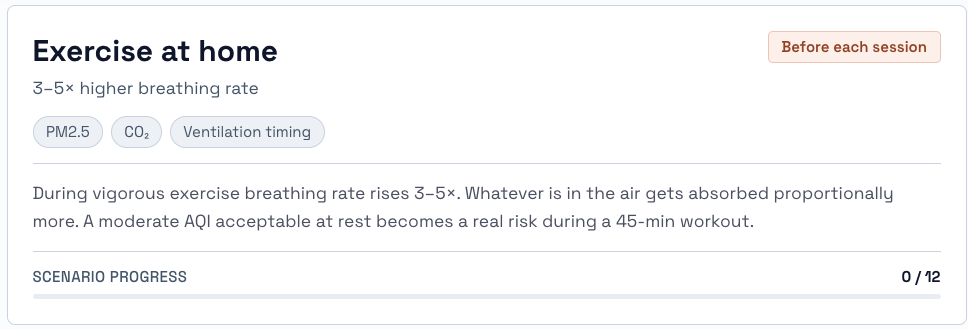
During vigorous exercise, breathing rate rises three to five times above resting levels. Whatever is in the air gets absorbed proportionally more. A moderate AQI you would barely notice at rest becomes a real risk during a 45-minute workout. This guide covers PM2.5, CO2 and ventilation timing: what actually matters before and during a home workout, and what to do about it.
At rest, an adult breathes roughly 5 to 8 litres of air per minute, depending on body size (darylconant.com, A Brief Discussion on Minute Ventilation). During vigorous exercise this typically climbs past 30 litres per minute. In trained athletes at peak effort it can reach 130 to 180 litres per minute, a 25- to 30-fold increase over resting values, though most home workouts by non-elite adults will land well below that ceiling, still many times resting values (RTM Vital Signs, Minute Ventilation as a Measure of Fitness and Endurance; darylconant.com).
The three-to-five-fold figure often quoted for exercise refers to breathing frequency alone, how many breaths you take per minute (PT Direct, Respiratory Responses to Exercise). Total air volume moved, which is what actually determines how much of a pollutant reaches your lungs, rises considerably more than that.
That is not a minor increase. A room's air quality, which barely registers when you are sitting on the sofa, becomes the air you are pulling through your lungs for the next 45 minutes.
Exercise physiologists have proposed a straightforward explanation. Raising minute ventilation increases the inhaled dose of whatever pollutants are present. More air passes through the lungs, and more of it comes in through the mouth rather than the nose, bypassing some natural filtration (McCafferty, cited in Effects of Ambient Particulate Matter on Aerobic Exercise Performance, PMC).
Fitness-studio air quality studies have measured this directly. Across moderate- and high-intensity indoor exercise classes, PM10 levels sometimes exceeded protective thresholds by over four times. Total inhaled pollutant dose was also consistently higher during high-intensity sessions than moderate ones (Inhalation exposure to indoor air pollutants during moderate- and high-intensity physical exercise in commercial fitness microenvironments, ScienceDirect).
The same physics apply to a home workout. The room does not change, but how much of its air quality problem reaches your bloodstream does.
This is not a reason to be nervous about exercising indoors. It means ventilation timing and purifier setup do more work here than in almost any other room in the home.
What actually matters before and during a session
Three things drive most of the risk:
- PM2.5, the fine particulate matter that infiltrates from outdoor pollution, and gets inhaled at a higher rate the harder you are working
- CO2, which builds up in a small, closed room faster than you would expect once breathing rate rises, and has been linked in controlled studies to reduced concentration and decision-making at levels commonly reached in a sealed room
- Ventilation timing, since whether opening windows helps or hurts depends on the outdoor AQI at that moment, not on habit
What to do right now
These do not require buying anything.
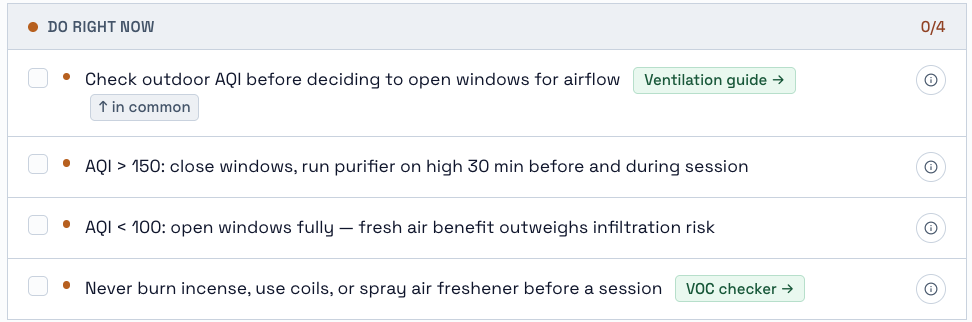
Check outdoor AQI before deciding to open windows for airflow. The most common mistake is opening windows out of habit, regardless of what is actually outside. Our ventilation guide can tell you in seconds whether outdoor air is currently cleaner than indoor air.
If AQI is above 150, close windows and run the purifier on high for 30 minutes before and during the session. Pre-clearing the room before you start means you are not breathing through the first 20 minutes of accumulated particulate matter while your ventilation rate is climbing fastest.
If AQI is below 100, open windows fully. Below this threshold, the benefit of fresh air outweighs the risk of infiltration. A closed room lets CO2 climb steadily as your breathing rate rises, and at this AQI level a stuffy room is the bigger problem, not particulate infiltration.
Never burn incense, use mosquito coils or spray air freshener before a session. Each releases a burst of particulate matter or VOCs right before you sharply increase how much air you are pulling through your lungs, the worst possible timing. Run what you already use through our VOC checker if you are not sure.
What to set up once
These take more effort but only need doing a single time.
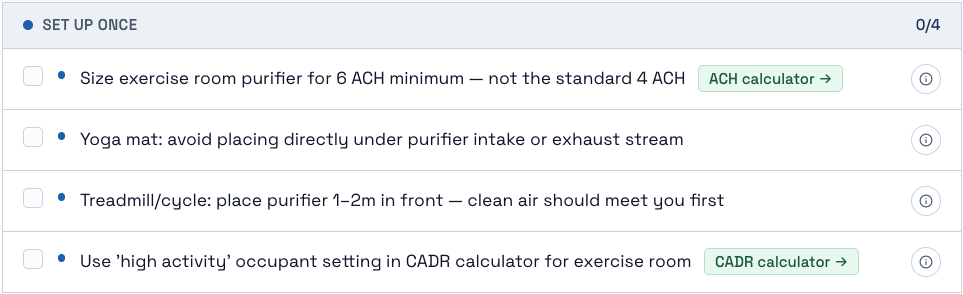
Size the exercise room purifier for 6 ACH minimum, not the standard 4 ACH. An exercise room needs a higher air-change rate than one used for sitting or sleeping, because the same room-air concentration delivers a disproportionately higher pollutant load to your lungs during exercise. Use our ACH Calculator to size correctly for the room.
Avoid placing a yoga mat directly under the purifier's intake or exhaust stream. Sitting in the exhaust stream means breathing already-filtered air a second time, before it has mixed with the rest of the room, which usually means the rest of the room is under-served. Sitting in the intake path does the opposite: it stirs dust from the mat itself straight into the filter zone.
For treadmill or cycle use, place the purifier one to two metres in front of you, not behind or to the side. The goal is for clean air to reach your breathing zone before you exhale into it, not to clean air that has already passed you by. A purifier behind you is mostly cleaning air you have already breathed. Our purifier placement guide covers the geometry in more detail.
Use the 'high activity' occupant setting in the CADR calculator when sizing for an exercise room. Standard occupant sizing assumes someone sitting or sleeping, not someone with a three-to-five-fold higher breathing rate. Our CADR Calculator has a setting specifically for this.
Signs worth watching for
A few things worth noticing as you go, even after the basics are in place.
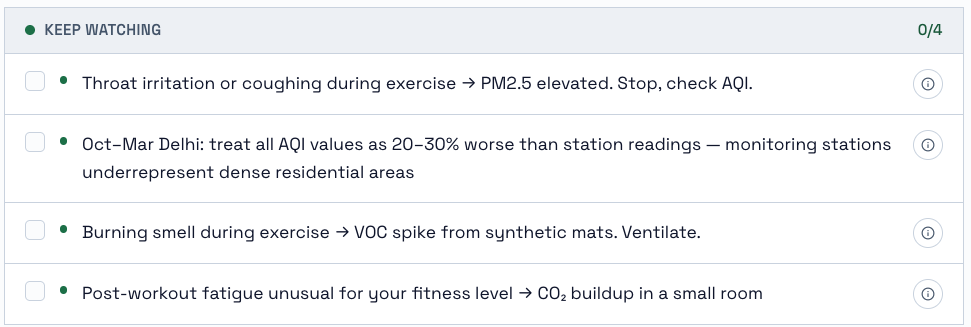
Throat irritation or coughing during exercise. This usually means PM2.5 is elevated beyond what the room can handle at your current breathing rate. Stop and check the AQI rather than pushing through it.
October to March in Delhi: treat all AQI values as 20 to 30% worse than station readings. Monitoring stations are typically placed in open areas and underrepresent the pollutant build-up in dense residential neighbourhoods, particularly during the winter inversion season. If the app says borderline, assume it is worse in your flat.
A burning smell during exercise. This points to a VOC spike, often from a synthetic yoga mat or rubber flooring heating up under friction and body heat. Ventilate the room rather than pushing through the smell.
Post-workout fatigue that feels unusual for your fitness level. Before assuming it is a bad training day, consider CO2 buildup in a small, sealed room. A closed door and windows for 45 minutes is enough time for CO2 to climb past 1,000 ppm, a level at which controlled studies have measured reduced decision-making and concentration, independent of how hard you actually worked (Satish et al., Environmental Health Perspectives, 2012; Allen et al., Environmental Health Perspectives, 2016).
Bottom line
Exercise does not change the pollutants in a room. It changes how much of them reach you, because a several-fold increase in air volume moved through your lungs means a correspondingly larger dose absorbed for the same room-air quality.
The fix is not complicated: check outdoor AQI before opening windows instead of doing it from habit, size your purifier and its placement for the higher breathing rate an exercise room actually sees, and treat throat irritation, unusual fatigue or burning smells as signals worth stopping for rather than pushing through.
For a personalised version of this checklist based on your specific home and city, use our Personal IAQ Checklist tool.
Related reading: Indoor air quality and toddlers — the same breathing-rate argument, applied to small children at floor level.
Sources: Resting and peak-exercise minute ventilation ranges: darylconant.com, A Brief Discussion on Minute Ventilation; RTM Vital Signs, Minute Ventilation as a Measure of Fitness and Endurance. Breathing frequency at rest versus intense exercise: PT Direct, Respiratory Responses to Exercise. Mechanism for increased inhaled pollutant dose during exercise: McCafferty, cited in Effects of Ambient Particulate Matter on Aerobic Exercise Performance (PMC); Air pollution, physical activity, and markers of acute airway oxidative stress and inflammation in adolescents (PMC). Fitness-environment pollutant exposure measurements: Inhalation exposure to indoor air pollutants during moderate- and high-intensity physical exercise in commercial fitness microenvironments (ScienceDirect). CO2 and cognitive performance: Satish, U. et al., "Is CO2 an Indoor Pollutant? Direct Effects of Low-to-Moderate CO2 Concentrations on Human Decision-Making Performance," Environmental Health Perspectives 120 (2012): 1671-1677; Allen, J.G. et al., "Associations of Cognitive Function Scores with Carbon Dioxide, Ventilation, and Volatile Organic Compound Exposures in Office Workers," Environmental Health Perspectives 124 (2016): 805-812. Note: a 2020 systematic review (Du et al., published via PubMed) found findings on CO2 and cognition are not fully consistent across all studies, so this link is well-supported but not universally settled. Air changes per hour: AHAM's published testing baseline alongside sizing guidance for higher-activity occupant settings, consistent with the 6 to 8 ACH range used across this site's own ACH and CADR calculators.
Email us at indoorairguide@outlook.com