When you shop for an air purifier, most listings lead with a coverage figure in square feet. It looks like the answer to the question you actually have: will this machine clean my room?
Often it can't tell you that. A coverage figure depends on how many times an hour the maker assumes the air is cleaned, and many listings don't say. The more useful number is CADR, the clean air delivery rate. When a maker publishes it, you can check it against the size of your room.
This guide explains how coverage figures are worked out, how to calculate the CADR your room needs, and how the air purifier finder does it for you in five questions.
Where coverage figures come from
Coverage figures are often calculated at far fewer than five air changes per hour (ACH). The Coway AirMega 250, for example, states 930 sq ft at 2 ACH. On mi.com/in, the Xiaomi Mijia 4 Compact and Mijia 6 also state 2 ACH. Dyson goes lower still: on dyson.in, the HushJet Compact and Big+Quiet carry a footnote of 1,076 sq ft at 1 ACH. Other brands leave the assumption off the page.
indoorair.guide sizes rooms at five ACH with a 10 ft ceiling. This is the site's baseline for healthy adults in Indian metros, not a national standard.
One more thing worth remembering: a purifier cleans one room. A unit in the living room won't clean a closed bedroom.
How to work out the CADR your room needs
The CADR a room needs is its volume multiplied by the air changes per hour. For a 250 sq ft room with a 10 ft ceiling:
250 sq ft × 10 ft ≈ 70.8 m³
70.8 × 5 = 354 m³/h
Delhi-NCR or high-AQI North India: × 1.25 ≈ 442 m³/h
The 1.25 is an uplift on the same five ACH baseline, applied only in Delhi-NCR or high-AQI North India. Nothing else is added on top.
For any room, the steps are the same: multiply the square footage by the ceiling height in feet, divide by 35.3 to get cubic metres, then multiply by 5. Add the 1.25 uplift if it applies to you. A 600 sq ft room with a 10 ft ceiling is about 170 m³, so it needs 850 m³/h, or about 1,062 m³/h with the uplift. The CADR calculator does the same arithmetic for any room dimensions.
Finding a purifier in five questions
The air purifier finder turns this into a shortlist. Specs come from manufacturer India pages. There is no sign-in, and there are no affiliate links.
Your answer to the first question sets the CADR target. Your other answers change which machines make the shortlist and how they rank, but never the target itself.
1. Room size
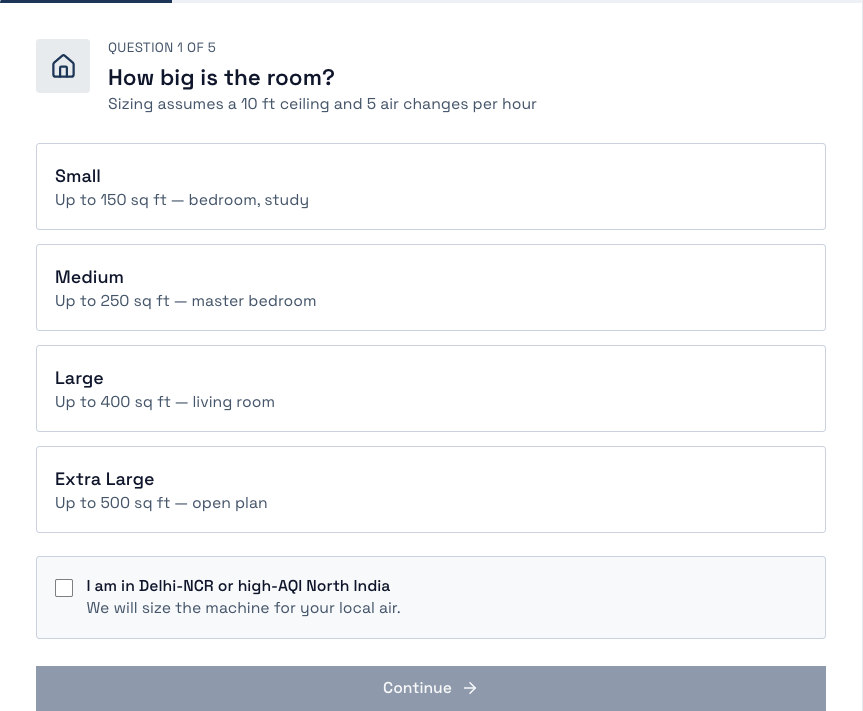
Pick the first band your room fits under: up to 150, 250, 400 or 500 sq ft. If you live in Delhi-NCR or high-AQI North India, tick the box below the options to apply the uplift. The finder stops at 500 sq ft, so for a larger room, use the steps above.
2. Main job
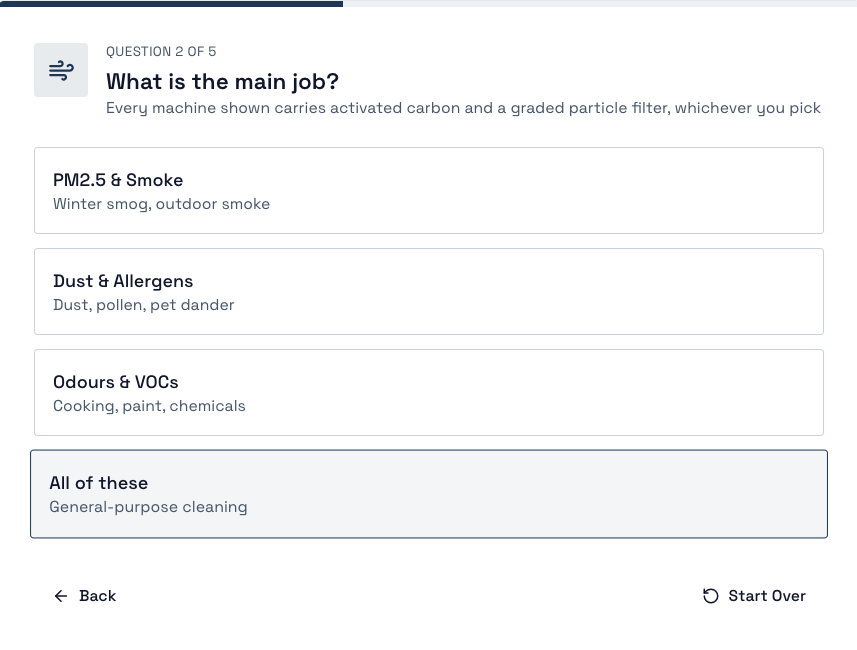
Tell the finder what you most want to remove: PM2.5 and smoke, dust and allergens, odours and VOCs, or all of these. Whatever you pick, every shortlisted machine has activated carbon and a graded particle filter. Boxes labelled “HEPA-type”, and ionisers with no CADR, are left out.
3. Budget
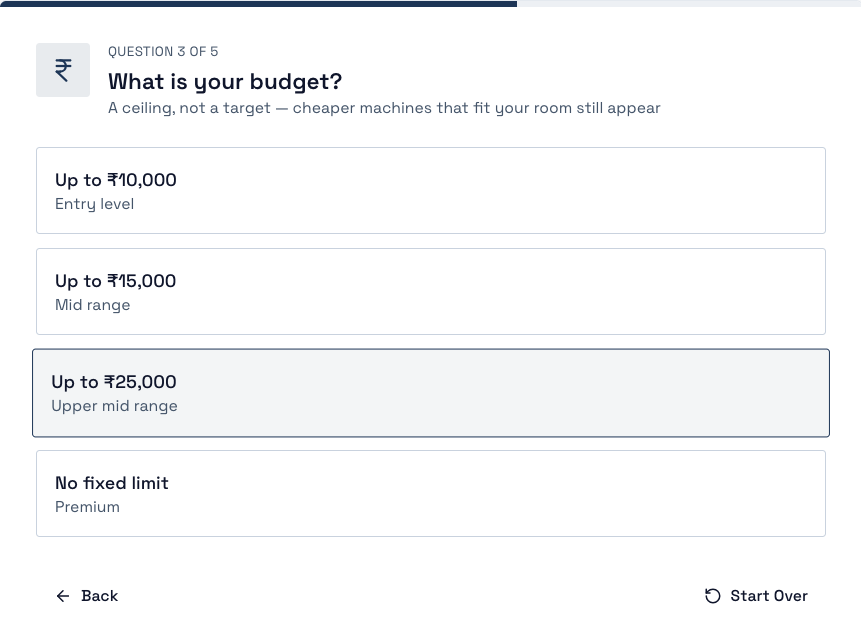
Choose up to ₹10,000, ₹15,000, ₹25,000, or no fixed limit. This is a ceiling, not a target, so cheaper machines that meet your CADR still compete.
4. Priority
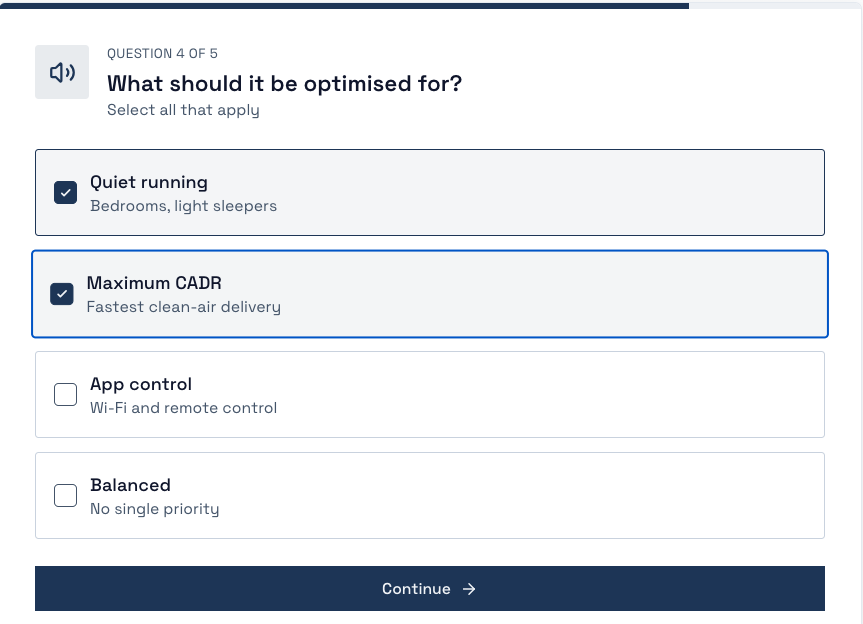
Listed CADR is measured at full fan speed, but a bedroom purifier usually runs slower at night. So quiet running looks at each machine's noise on its lowest mode, and maximum CADR favours the highest published figure. If the purifier is for a bedroom, tick quiet running.
5. How it will run
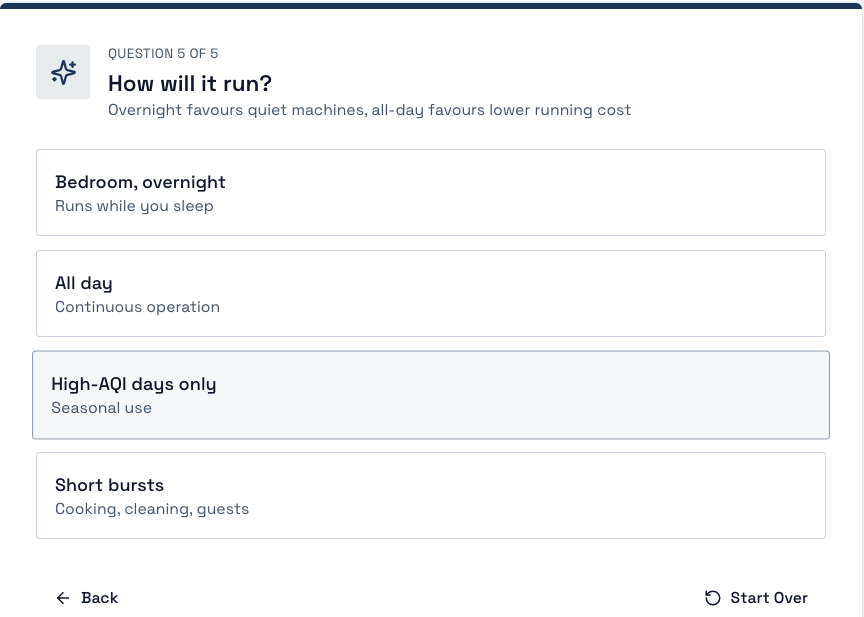
Choose overnight, and the finder keeps only machines at 30 dB or less on their lowest mode, provided at least one of them matches your other answers. All-day use favours machines that cost less to run. High-AQI days and short bursts lean towards higher CADR.
Reading your shortlist
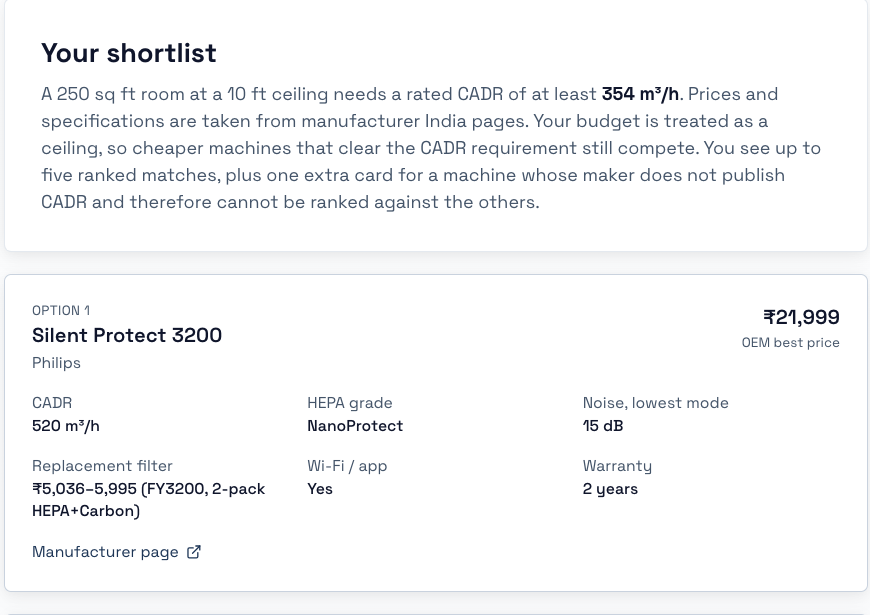
Your results open with the CADR target for your room. It's worth noting down, because you can check it against any listing that publishes a standard CADR.
Below it are up to five ranked cards. Each shows the price, CADR, filter grade, noise on the lowest mode, replacement filter, app support and warranty.
Machines without a standard CADR are not ranked. Dyson can appear as one extra card because it publishes a different whole-room test rather than a CADR, so that card is marked “not comparable”.
Frequently asked questions
Is the coverage figure on a purifier listing wrong?
Not necessarily. Where makers state their assumption, it is often far fewer air changes per hour than the five indoorair.guide uses, and many listings don't state it at all. CADR lets you check a machine against your own room.
What CADR does a 250 sq ft room need?
At a 10 ft ceiling and five air changes per hour, about 354 m³/h. In Delhi-NCR or high-AQI North India, about 442 m³/h.
Can one purifier clean my whole home?
Not if the rooms are closed off from each other. A purifier cleans the room it is in, so a unit in the living room won't clean a closed bedroom.
Why is Dyson not ranked with the other machines?
Dyson publishes a different whole-room test rather than a standard CADR, so its machines can't be compared on the same basis.
The short version
Work out the CADR your room needs, and when you compare purifiers, trust the published CADR over the coverage figure.
Start here: find your air purifier. Further reading: the interactive buying checklist and HEPA 13 vs HEPA 14.
Questions about sizing a specific room? Email us at indoorairguide@outlook.com.
indoorair.guide is not affiliated with any brand. Check the manufacturer's page before you buy.